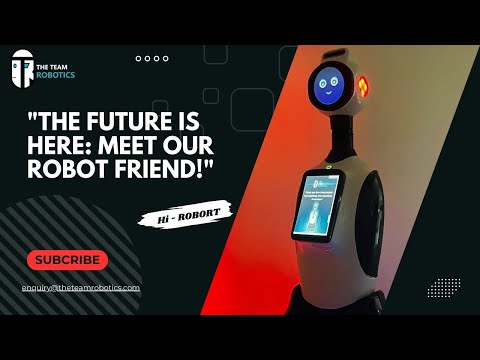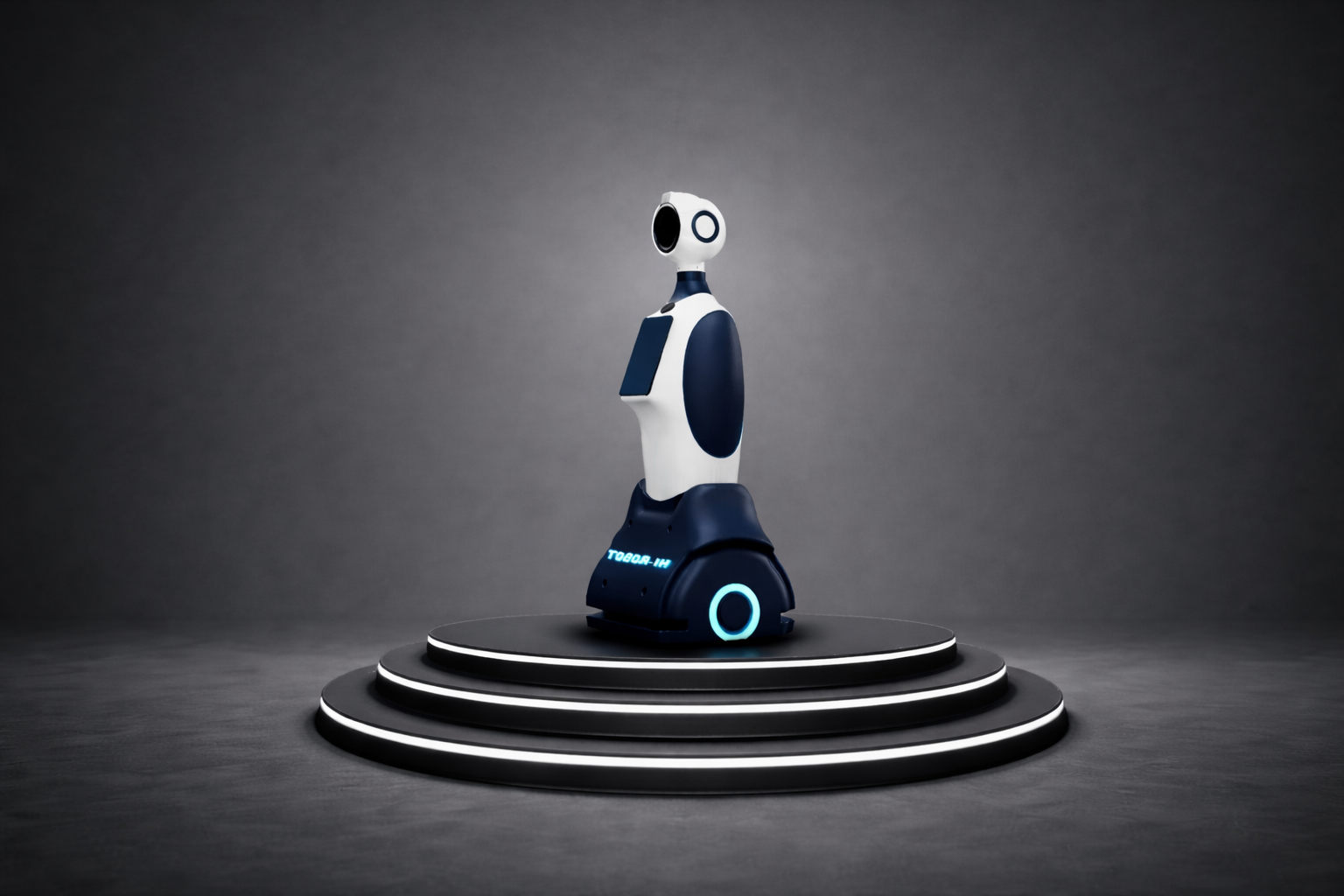

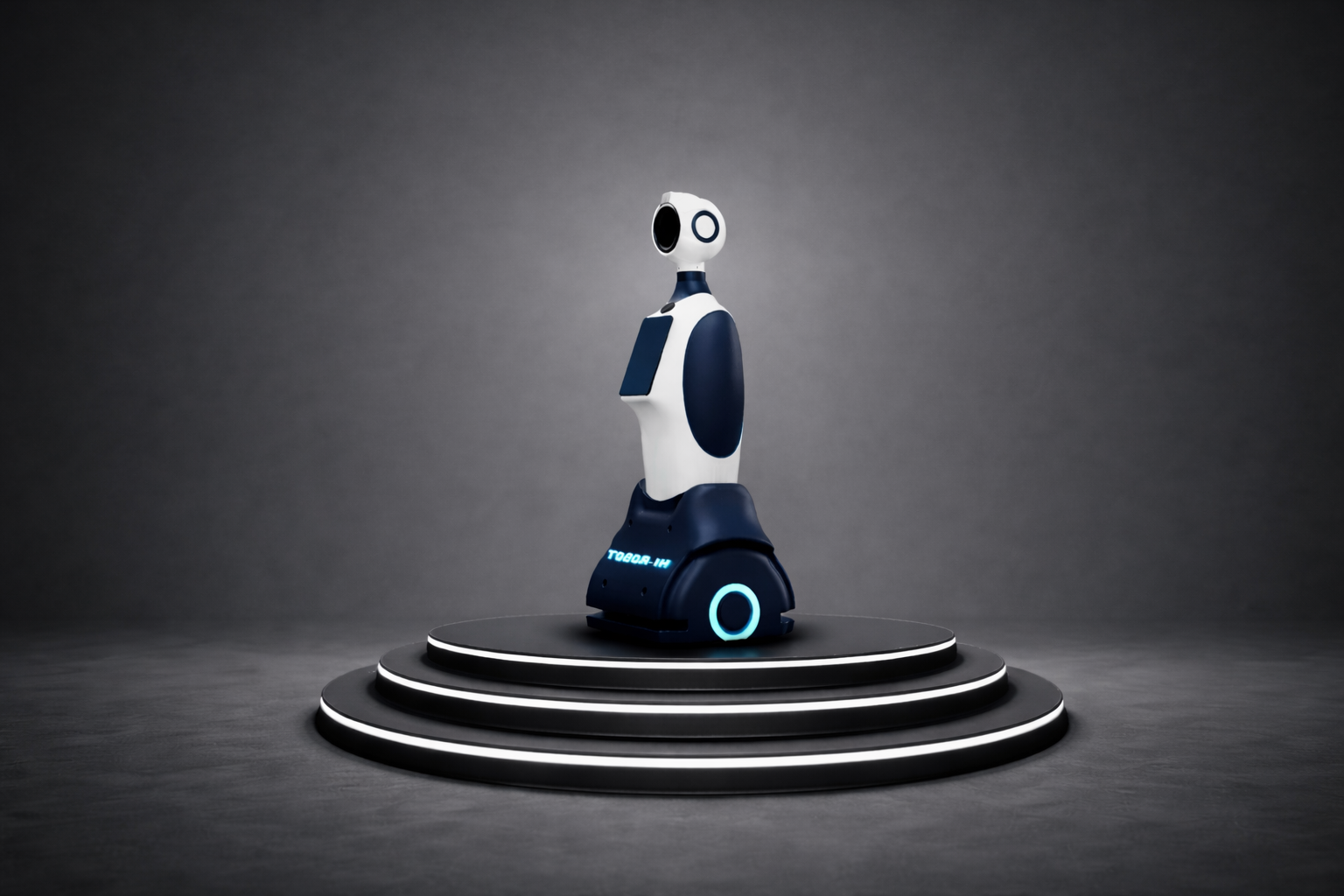
Develop an intelligent service robot capable of interacting with users through voice commands, providing information, and autonomously navigating indoor environments to assist people in public and commercial spaces.

A multidisciplinary team including robotics engineers, AI developers, software engineers, and business analysts collaborated to design, develop, and integrate the robot’s navigation, conversational AI, and user interface systems.

4–6 Monthss

The project focuses on enabling seamless human-robot interaction through voice recognition, multilingual communication, autonomous navigation, and touchscreen-based services, making it suitable for deployment in offices, hotels, educational institutions, and public environments.
The client is a technology-driven organization focused on developing innovative robotics solutions for service and automation industries. Their goal is to enhance customer engagement and operational efficiency through intelligent robotic systems in environments such as offices, hotels, educational institutions, and public spaces.
The client required an interactive service robot capable of assisting users, providing information, and navigating autonomously in indoor environments. The solution needed to deliver a smooth human-robot interaction experience while ensuring reliability and safety in public spaces.
Key Requirements:
Voice-based interaction for answering user queries
Autonomous navigation with obstacle avoidance
Multi-language communication support
Touchscreen interface for easy user interaction
Ability to guide users to specific locations
Real-time information assistance
Ensuring accurate voice recognition in noisy environments
Safe navigation in crowded public spaces
Integrating multiple technologies such as AI, navigation, and UI
Supporting multiple languages for diverse users
Maintaining smooth interaction between users and the robot
Successfully developed an intelligent service robot for public interaction
Improved user engagement through voice and touchscreen interfaces
Enabled safe and efficient autonomous navigation
Provided multi-language support for better accessibility
Enhanced information assistance and user guidance
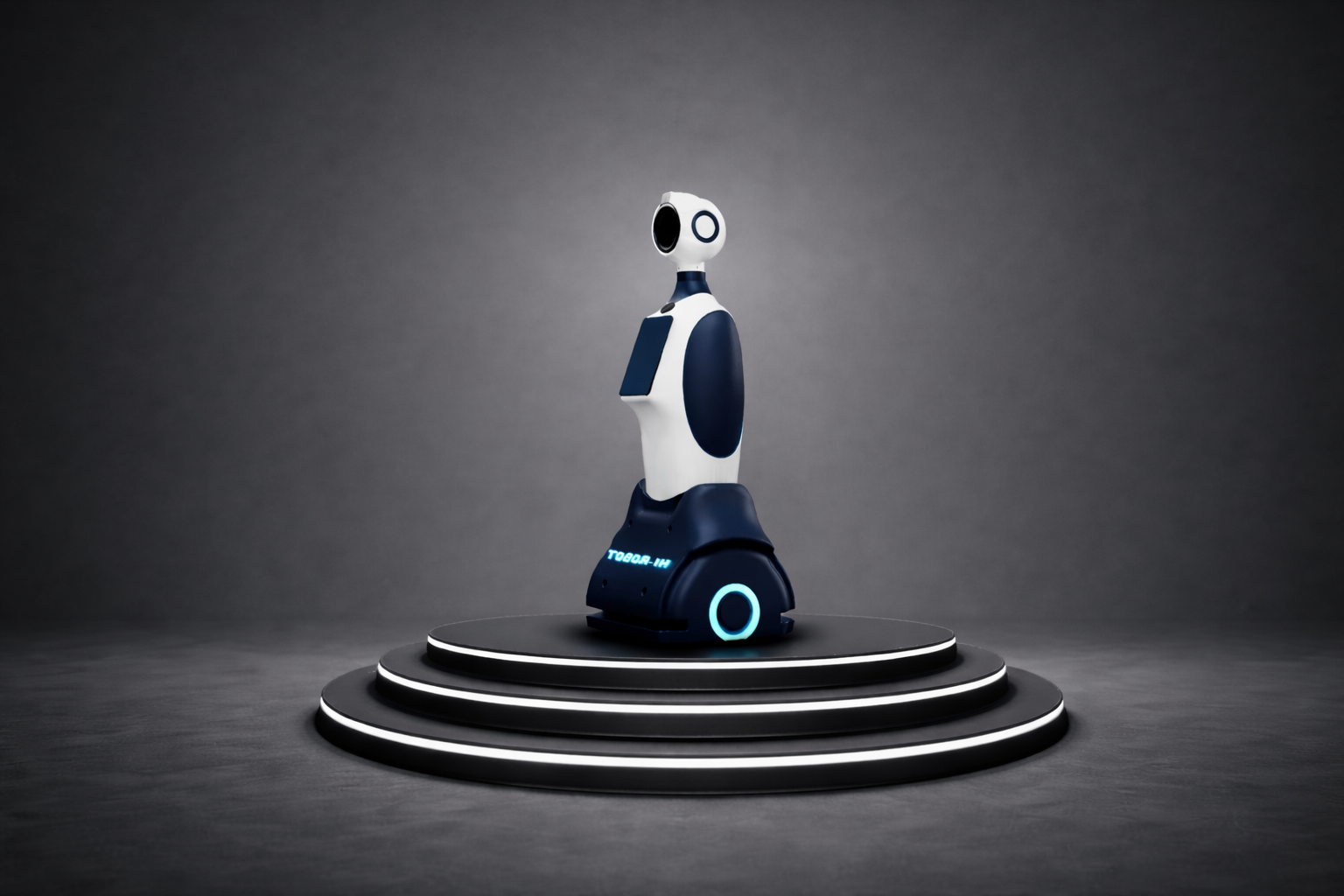
Our team followed a structured development approach by analyzing the client’s requirements, designing the system architecture, and integrating AI-based interaction with autonomous navigation. The focus was on creating a reliable and user-friendly robotic solution suitable for real-world environments.
Approach Steps:
Requirement analysis and system planning
Designing navigation and interaction modules
Integration of voice recognition and AI-based responses
Development of touchscreen interface for user interaction
Testing navigation accuracy and obstacle avoidance
Continuous improvements based on testing and feedback
WAS is an innovative Forecast weather alert system designed and developed using the API from National Environment Agency (NEA).
.png)
The IoT robotics solution helped us automate critical warehouse workflows while maintaining real-time visibility into operations. Productivity improved significantly.